Category: Uncategorized

iPhone Tip Of The Day! How to block a caller.

Do you have a stalker?


If the answer to that question is yes, you should probably speak to the police. But this might help too.


To block a caller, go to their most recent call. Add them as a contact. Use fake names, like Stupidhead Don’tanswer.


Now, go to Settings> Phone> Blocked> Add New.


BAM! Stupidhead Don’tanswer can no longer call, message or Facetime you. Sucker.


Read Craig Federighi’s Op-Ed about the Apple V FBI case


The Apple Vs FBI case is heating up.


The case concerns the FBI asking Apple to unlock one of the iPhones used by one of the San Bernadino shooters. Apple has said that doing so would set a dangerous precedent, and privacy is a vital part of the issue.


Senior Vice President of Software Engineering Craig Federighi has written an op-ed  for the Washington Post, explaining Apple’s position. It’s a worthwhile read for an important issue.


Check it out here.


Deal of the Day! $300 off Macbooks at Best Buy!

macbook


Get thee to a Best Buy! Right now they have 2015 Apple MacBooks at $300 off list price!


Open box items also scaled to discount!!!!


Before you get thee there, go to your local post office and get the Movers discount pack (free) and inside you’ll fine a 10% off coupon for Best Buy. Use that.


If you’re a student with a .edu email address, you can get an additional $50 off.


Holy Mackeral that’s some cheap Macbooks.


Cheeeeek it out! 


Future Tech of the week Ski edition


Carvskiing


Do you like to Ski? If the answer is yes, 1, Can we come ride with you sometime? and 2, You should check out this new tech that is designed to help make you a better skier.


Carv is a wearble that gives you real time feedback, data anaylsis, and actes as your digital Ski coach. How cool is that? (insert ice cold joke here).


It’s an extremely thin smart insert that measures your motion and pressure distribution and relays feedback through your earphones- in real-time. Whaaat. You can pick drills, keep track of your achievements and personal bests for each ski run, challenge yourself or a friend to a technical drill and find out who is the most versatile skier.


It also connects wirelessly to your smartphone with detailed metrics and analysis. Whether you’re advanced, pro, or casual, Carv will help you ski.


For every turn you make Carv analyses when, where and how much pressure you apply. Carv then speaks to you to correct your form in real-time on the slopes and later provides in-depth run analysis in the app.


Carv is on Kickstarter, currently sitting pretty with 545 backers that have pledged $114,520 of $50,000 goal with 40 days to go. Pledge $169 and you can get in on the Carv action!


Check out the kickstarter here. 


Apple will fix the latest brick problem

Apple has  acknowledged the “1970” date bug affecting 64-bit iPhone, iPad, and iPod touch devices.


If you don’t know about this bug, maybe it’s best. If you really want to know – read on. Manually changing the date to May 1970 or earlier results in a continuous reboot cycle and will  prevent your iOS device from turning on after a restart. Crimeny!


This video explains why the issue may occur:


Apple say that a fix will be available in an upcoming iOS software update.
If you do have this issue restoring through iTunes in DFU Mode may work. It’s best to contact Apple Support.


Big Tech behind Apple on opposition of FBI orders

Apple have been asked ( ordered) by the FBI to create a backdoor into an iPhone owned by one of the San Bernadino shooters, and, controversially, they have refused. (See CEO Tim Cook’s open letter to customers regarding this here).


Yesterday, both Facebook and Twitter raised their strong tech voice to stand alongside Apple.


The order the FBI made specifically requires that Apple creates a version of iOS that would let it crack the passcode on the iPhone 5c used by San Bernardino shooter Syed Farook.


Specifically, these are the orders.


1. Eliminate the auto-erase function that wipes an iPhone if the wrong passcode is entered 10 times.
2. Eliminate the delay that locks the FBI out of the iPhone if the wrong passcode is entered too many times in a row.
3. Implement a method that would allow the FBI to electronically enter a passcode using software.


Apple calls this a ‘dangerous precedent’. Others in the tech world agree.
From Twitter CEO Jack Dorsey:


Facebook shared its announcement through a statement with USA Today:


“We condemn terrorism and have total solidarity with victims of terror. Those who seek to praise, promote, or plan terrorist acts have no place on our services. We also appreciate the difficult and essential work of law enforcement to keep people safe,” the statement reads. “When we receive lawful requests from these authorities we comply. However, we will continue to fight aggressively against requirements for companies to weaken the security of their systems. These demands would create a chilling precedent and obstruct companies’ efforts to secure their products.”


Google CEO Sundar Pichai supports Apple, and in a statement has also called the FBI’s request a “troubling precedent”. WhatsApp CEO Jan Koum and several advocacy groups, including the Electronic Frontier Foundation, Fight for the Future, and the American Civil Liberties Union have also voiced their support.


Thursday Afternoon Apple Ad time!

Bout time we had a new Ad, Apple. We want pretty pictures and music and iPhones!  Just like this.


Tim Cook’s Open letter

Apple CEO Tim Cook has posted an open letter to Apple customers regarding the order by a U.S. Federal judge to help the FBI access data on an iPhone 5c used by San Bernardino shooter Syed Farook.


In it, he talks about why Apple are opposing the order. It’s a very interesting and important read.


February 16, 2016


A Message to Our Customers


The United States government has demanded that Apple take an unprecedented step which threatens the security of our customers. We oppose this order, which has implications far beyond the legal case at hand.


This moment calls for public discussion, and we want our customers and people around the country to understand what is at stake.


The Need for Encryption
Smartphones, led by iPhone, have become an essential part of our lives. People use them to store an incredible amount of personal information, from our private conversations to our photos, our music, our notes, our calendars and contacts, our financial information and health data, even where we have been and where we are going.


All that information needs to be protected from hackers and criminals who want to access it, steal it, and use it without our knowledge or permission. Customers expect Apple and other technology companies to do everything in our power to protect their personal information, and at Apple we are deeply committed to safeguarding their data.


Compromising the security of our personal information can ultimately put our personal safety at risk. That is why encryption has become so important to all of us.


For many years, we have used encryption to protect our customers’ personal data because we believe it’s the only way to keep their information safe. We have even put that data out of our own reach, because we believe the contents of your iPhone are none of our business.


The San Bernardino Case
We were shocked and outraged by the deadly act of terrorism in San Bernardino last December. We mourn the loss of life and want justice for all those whose lives were affected. The FBI asked us for help in the days following the attack, and we have worked hard to support the government’s efforts to solve this horrible crime. We have no sympathy for terrorists.


When the FBI has requested data that’s in our possession, we have provided it. Apple complies with valid subpoenas and search warrants, as we have in the San Bernardino case. We have also made Apple engineers available to advise the FBI, and we’ve offered our best ideas on a number of investigative options at their disposal.


We have great respect for the professionals at the FBI, and we believe their intentions are good. Up to this point, we have done everything that is both within our power and within the law to help them. But now the U.S. government has asked us for something we simply do not have, and something we consider too dangerous to create. They have asked us to build a backdoor to the iPhone.


Specifically, the FBI wants us to make a new version of the iPhone operating system, circumventing several important security features, and install it on an iPhone recovered during the investigation. In the wrong hands, this software — which does not exist today — would have the potential to unlock any iPhone in someone’s physical possession.


The FBI may use different words to describe this tool, but make no mistake: Building a version of iOS that bypasses security in this way would undeniably create a backdoor. And while the government may argue that its use would be limited to this case, there is no way to guarantee such control.


The Threat to Data Security
Some would argue that building a backdoor for just one iPhone is a simple, clean-cut solution. But it ignores both the basics of digital security and the significance of what the government is demanding in this case.


In today’s digital world, the “key” to an encrypted system is a piece of information that unlocks the data, and it is only as secure as the protections around it. Once the information is known, or a way to bypass the code is revealed, the encryption can be defeated by anyone with that knowledge.


The government suggests this tool could only be used once, on one phone. But that’s simply not true. Once created, the technique could be used over and over again, on any number of devices. In the physical world, it would be the equivalent of a master key, capable of opening hundreds of millions of locks — from restaurants and banks to stores and homes. No reasonable person would find that acceptable.


The government is asking Apple to hack our own users and undermine decades of security advancements that protect our customers — including tens of millions of American citizens — from sophisticated hackers and cybercriminals. The same engineers who built strong encryption into the iPhone to protect our users would, ironically, be ordered to weaken those protections and make our users less safe.


We can find no precedent for an American company being forced to expose its customers to a greater risk of attack. For years, cryptologists and national security experts have been warning against weakening encryption. Doing so would hurt only the well-meaning and law-abiding citizens who rely on companies like Apple to protect their data. Criminals and bad actors will still encrypt, using tools that are readily available to them.


A Dangerous Precedent
Rather than asking for legislative action through Congress, the FBI is proposing an unprecedented use of the All Writs Act of 1789 to justify an expansion of its authority.


The government would have us remove security features and add new capabilities to the operating system, allowing a passcode to be input electronically. This would make it easier to unlock an iPhone by “brute force,” trying thousands or millions of combinations with the speed of a modern computer.


The implications of the government’s demands are chilling. If the government can use the All Writs Act to make it easier to unlock your iPhone, it would have the power to reach into anyone’s device to capture their data. The government could extend this breach of privacy and demand that Apple build surveillance software to intercept your messages, access your health records or financial data, track your location, or even access your phone’s microphone or camera without your knowledge.


Opposing this order is not something we take lightly. We feel we must speak up in the face of what we see as an overreach by the U.S. government.


We are challenging the FBI’s demands with the deepest respect for American democracy and a love of our country. We believe it would be in the best interest of everyone to step back and consider the implications.


While we believe the FBI’s intentions are good, it would be wrong for the government to force us to build a backdoor into our products. And ultimately, we fear that this demand would undermine the very freedoms and liberty our government is meant to protect.


Tim Cook


What do you guys think?


Tesla Model 3 is coming!

Are you a fan or Tesla cars? What about… way cheaper Teslas? What do you think about that? At iPhone Antidote, we think really, really good things about that. Good thing, then, that come March 31st people all over  will be able to reserve a Model 3 Tesla.


The Model 3 is expected to hit the $35,000 retail price target, and, some are predicting that it will be as cheap as $22,000 after electric vehicle tax incentives.


Holy car-that’s-good-for-the-environment, batman! That’s cheap!


The Model 3 will be revealed to the world on March 31st, and folks can reserve one then,  however it won’t actually go on sale until late 2017. Sorry guys.


The Model S was the best-selling “comparably priced” sedan in the US last year. In 2016 Tesla is planning to open 80 more retail and service centers, and add some 300 new Supercharger locations.


Come on 2017!

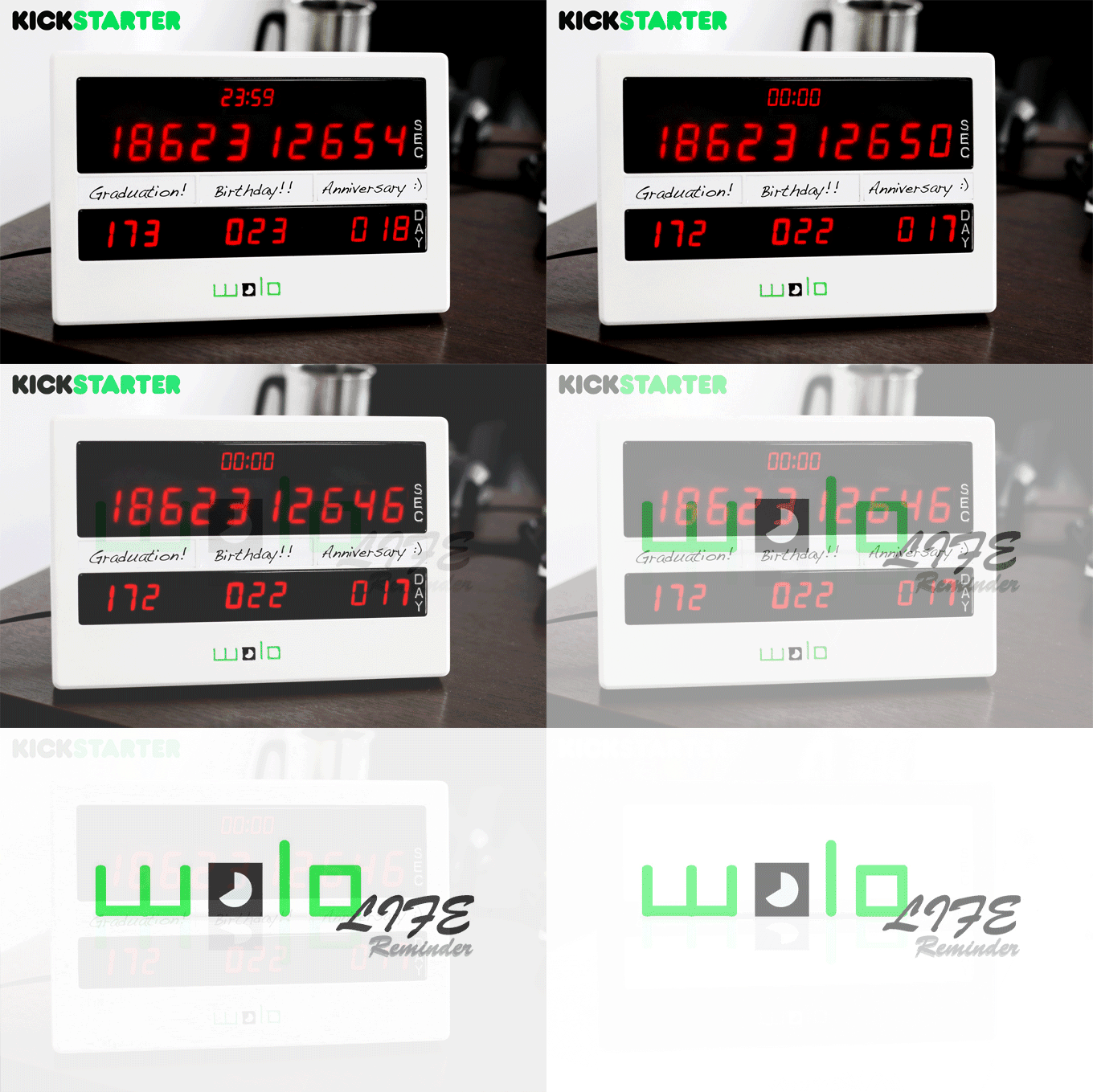
Future Tech Of The Week! WOLO Life Clock

lifeclock


You know how looking at the clock can keep you on track with your day and your goals? Well, take that idea, and times it by a thousand. Introducing the WOLO Life clock.


A visual timer that shows you how much time you have left to live.


Time management is key to living life to the fullest, as is prioritizing what you do with your time on earth, and using it wisely. WOLO Life clock helps you do just that, and we’re all about it. We understand how time can pass without understanding that those seconds never come back.


Simply key in your date of birth and country of origin, and the Importance Tab on the WOLO Life Reminder will start to run – counting down your life in seconds.


As well as the importance tab, you have the Urgency Tab  which counts down to 3 important days chose by you.


The WOLO Life Clock is a Kickstarter campaign that raised $30,275 of their $30,000 goal with the help of 118 backers. Check out their Kickstarter campaign here!